58同城
China’s market structure improves in H1 as AI, robots drive emerging industries_我的网站

A |
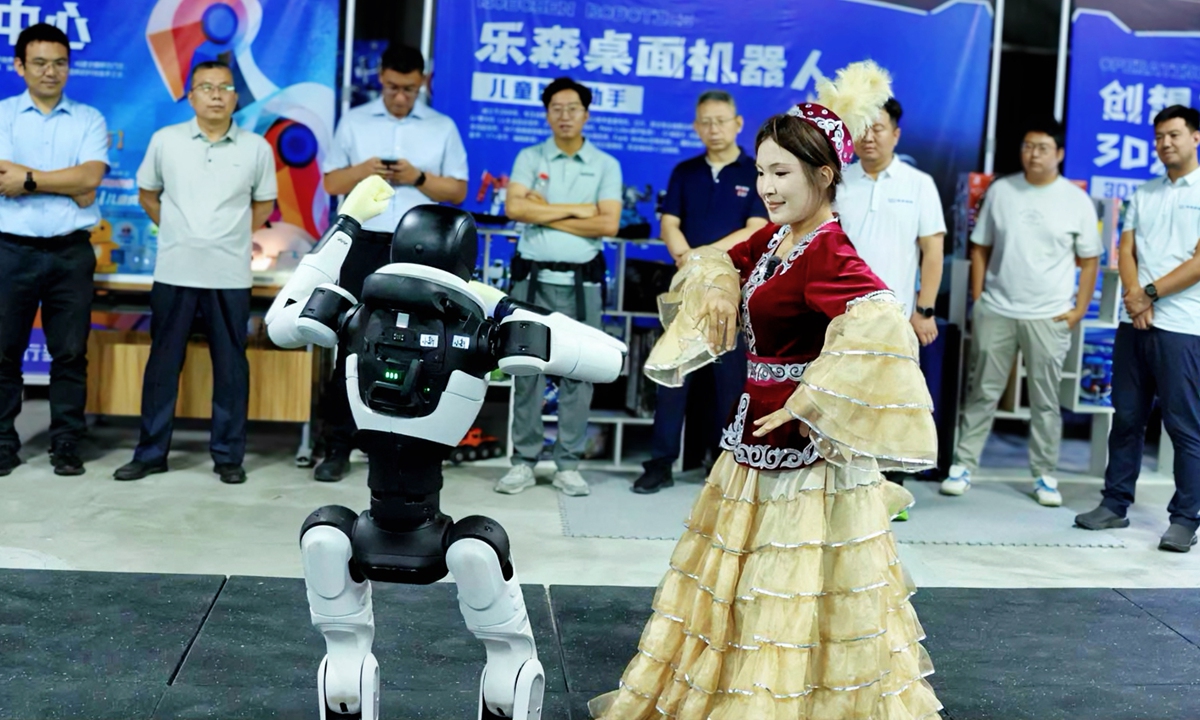
A Xinjiang local resident dances with a robot at the temporary exhibition hall at the region's first robotics 9S center on July 31, 2026. Photo: courtesy of the Xinjiang Future Era Information Technology Co, the operator of the project
China's market landscape experienced a structural optimization in the first half of 2026, powered by a lineup of emerging and future-oriented industries.
Official data from the State Administration for Market Regulation (SAMR) shows 561,000 new enterprises were registered across China's strategic emerging and future industries, spanning next-generation information technology, high-end equipment manufacturing, generative artificial intelligence (AI) and humanoid robotics.
The rapid expansion of these new market players is revamping China's industrial layout and fast-tracking the cultivation of new quality productive forces, underpinning steady high-quality economic upgrading, experts said.
Cutting-edge technology sectors stood out as the brightest growth spots, posting explosive year-on-year expansion. The generative AI industry recorded a 28 percent surge in new start-ups with 55,000 newly established firms, while the humanoid robot sector saw a 9.5 percent rise, adding 116,000 new enterprises.
"It shows that China's innovation momentum is exceptionally strong and remarkably broad-based — a trait that is virtually unique in the global landscape," Chen Jing, a vice president of the Technology and Strategy Research Institute, told the Global Times on Sunday. "The explosive growth of new enterprises in AI and robotics reflects the extraordinary depth and diversity of China's industrial ecosystem."
Outside high‑tech sectors, 3.957 million new services‑sector enterprises were established and booming emerging‑consumption businesses injected fresh impetus into domestic demand, the SAMR said.
The number of new firms in software and telecommunications services rose 3.3 percent to 322,000. Inspection‑and‑testing businesses soared 43.9 percent, and entities dedicated to the commercialization of scientific‑research achievements climbed 6.8 percent to 459,000.
Manufacturers accelerated industrial upgrading with companies moving up the value‑chain ladder, the SAMR said.
High‑end equipment industries have maintained growth during the first half, with 28,000 newly registered firms and a year‑on‑year increase of 2.5 percent.
A total of 330,000 high‑tech‑manufacturing enterprises were operating as of the end of June, including 15,000 newly established ones. Start‑ups engaged in the production of spacecraft and launch vehicles rocketed 185.7 percent. New producers of fiber optic cables climbed 129.4 percent and integrated‑circuit businesses increased by 24.2 percent.
"We are witnessing a dual-engine growth model, where new consumption in the services sector and high-tech services reinforce each other, while the digital and real economies integrate at an accelerating pace. At the same time, the intelligent transformation of manufacturing is picking up speed," Chen said.
The dividends from this industrial transformation are generating a powerful multiplier effect, creating a virtuous cycle led by innovation, Chen noted.
"The first‑half growth and structural shifts among China's market‑based businesses mirrored the country's overall economic momentum and industrial makeup. New‑emerging sectors, core strategic pillar industries and forward‑looking future industries registered the fastest business expansion," Tian Yun, a veteran economist, told the Global Times on Sunday.
These solid achievements fully reflect the success of China's innovation-driven economic strategy.
Strong policy support for specialized, sophisticated, unique and innovative enterprises has fueled this industrial boom while these market players have helped China shore up, upgrade and extend its industrial chains, Tian noted.
This business boom lines up with this year's stellar foreign trade figures, Tian noted.
China's exports rose 23.9 percent year-on-year in dollar terms in July, data from the General Administration of Customs showed on Friday.
Exports of high-tech products, including industrial robots and 3D printers, surged by more than 50 percent year-on-year, outpacing the 39 percent growth recorded in the first half of the year, according to the Xinhua News Agency.
The growing pool of high‑quality market players signaled lasting improvements in China's global competitiveness, industrial upgrading capacity and the standard of goods and services. Broader product ranges, better‑made commodities and improved supporting services will deliver durable new‑growth momentum, Tian noted.
。 Washington, Oct 14 (UNI) The global economy is "dangerously close" to a recession, as inflation remains elevated, interest rates rise, and growing debt burden hits the developing world, World Bank President David Malpass said.
"We've lowered our 2023 growth forecast from 3 per cent to 1.9 per cent for the global growth, that's dangerously close to a world recession," Malpass on Thursday said at a press conference during the IMF and World Bank annual meetings.
"All of the problems that people have taken note of, the inflation problem, the interest rate rises, and the cutoff of capital flow to developing world hit the poor hard," he said, highlighting the buildup of debt for developing countries.
"That's a world recessions could happen under certain circumstances," Malpass said.
In a study published in mid-September, the World Bank warned that as central banks across the world simultaneously hike interest rates in response to inflation, the world may be edging toward a global recession in 2023, with a growth forecast of only 0.5 per cent.
The World Bank chief noted at the press conference that world population growth is estimated at 1.1 per cent per year. "So if you get much slower in terms of world growth, that means people are going backward," Malpass said in response to a question from Xinhua.
Citing a recent World Bank report, Malpass said that Covid-19 pandemic dealt the biggest setback to global poverty-reduction efforts since 1990, pushing about 70 million people into extreme poverty in 2020, and the war in Ukraine threatens to make matters worse.
According to the Poverty and Shared Prosperity Report, global median income declined by 4 per cent in 2020, the first decline since its measurements of median income began in 1990.
"So if we have a world recession now, that would also depress median income, meaning that the people in the lower half of the income scale are going down," Malpass said.
The World Bank chief also noted that he has been concerned about the concentration of capital in the world in the top end of the advanced economies.
"So that's, I think, one of the issues that the world has to deal with to allow capital to flow to new businesses and to developing countries, that would take a change in the direction of fiscal and monetary policies in the advanced economies," said Malpass.
The world is facing very challenging environment from the advanced economies, and that has serious implications, dangers for the developing countries, he said. "My deep concern is that these conditions and trends might persist into 2023 and 2024."
UNI/XINHUA PRT。

B |
Current article:http://ad6.tichannangenzhuchuapin.cfd/pumadyi/90jkua.html
Published on:21:10:54